Original source: resource.co
La entrada ‘Consumer consciousness around food waste’ has doubled since 2020, report says se publicó primero en Shelfmanager.
]]>According to new research by the Capgemini Research Institute, ‘consumer consciousness around food waste has more than doubled in the past two years’.
food wasteAccording to the report – ‘Reflect, Rethink, Reconsider’ – rising food prices, supply chain challenges, the pandemic and sustainability concerns have changed consumer behaviour. The Institute surveyed 10,000 consumers, as well as executives from 1,000 large organisations in food manufacturing and retail.
Today, 72 per cent of consumers are aware of their food wastage, compared to 33 per cent of consumers in 2020, Capgemini says. The report also recorded an 80 per cent ‘year-on-year growth’ in social media searches for methods to increase the life of food items.
The Institute states that this increased consideration for food waste is the direct result of cost savings (56 per cent), concerns about world hunger (52 per cent) and climate change (51 per cent).
Research also shows that 60 per cent of consumers feel ‘guilty’ about wasting food, yet ‘nearly 61 per cent of consumers want brands and retailers to do more to help them tackle food waste’. 57 per cent are also disappointed as they feel that businesses don’t care enough about the issue.
Consumers are reportedly dissatisfied with the action currently taken by organisations to tackle food waste, such as offering advice on keeping leftovers. Despite 60 per cent of organisations saying they provide clarity on terms like ‘best before’, ‘consume by’ and ‘expiry date’, 61 per cent of consumers believe that this is enough.
According to Capgemini, consumers want organisations to do more – such as providing customers with ‘digital labels (QR codes, etc.)’ that offer more transparency on the product’s journey and quality.
Consumers feel left to their own devices in terms of reducing food waste, the report highlights. When trying to increase food longevity at home, 67 per cent go to third-party sources for information (friends, family, influencers, and social media), with only 33 per cent getting information from packaging, commercials or campaigns run by food manufacturers and retailers.
Consumer education and support
Due to increased consumer awareness of food waste, the Institute’s report urges food retailers and manufacturers to ‘take action’ and gain consumer confidence.
Capgemini found that 91 per cent of consumers are willing to buy from brands and retailers that disclose information on their food waste, while 58 per cent will increase their spend with companies taking active steps to manage food waste.
A ‘fragmented food chain’
The report also highlights how the production and distribution stages contribute to food waste, with the Worldwide Fund for Nature (WWF) reporting that “over 15 per cent of food is lost before leaving the farm”.
Despite 77 per cent of organisations claiming to have committed to the United Nations’ Sustainability Development Goals – to reduce food losses along production and supply chains – only 15 per cent say they have achieved this goal, or are on track to meet their targets.
According to Capgemini, 44 per cent of food retailers and 50 per cent of manufacturers focus on reducing food waste in upstream logistics. In comparison, only 22 per cent of retailers and 23 per cent of manufacturers pay the same attention to agricultural production. In terms of downstream storage – only 18 per cent of retailers and 21 per cent manufacturers maintain this focus.
Technology as a solution
To ‘help accelerate the fight against food waste’, the report recommends a three-pronged approach, backed by technology:
- Engage consumers and employees in food waste management initiatives
- Collaborate across the value chain
- Set, monitor, and report food waste-related metrics
Tim Bridges, Global Sector Lead, Consumer Products, Retail and Distribution at Capgemini, said: “The increased awareness amongst consumers and the initiatives being taken by businesses to tackle food waste is a positive step forward.
“With the help of technology, organisations can track and assess food waste at every stage of the food value chain to enable action at the right time, while also engaging with their consumers by inculcating waste avoiding behaviours and making them an active participant in waste reduction.
“An agile, intelligent supply chain can also enable an effective collaboration across the value chain to create a sustainable and future-ready ecosystem.”
La entrada ‘Consumer consciousness around food waste’ has doubled since 2020, report says se publicó primero en Shelfmanager.
]]>The objective is to experience the store from the customer's perspective...
La entrada Phantom inventory 101: Its symptoms and how to treat it se publicó primero en Shelfmanager.
]]>Let’s put ourselves in the following situation: an in-store walk-through.
The objective is to experience the store from the customer’s perspective to assess whether the standards defined by the company are met.
When walking down the aisles, it is impossible to avoid noticing empty shelves, locations that do not have enough stock, out-of-stock products generating dead areas, and others that cover more than the optimum, taking advantage of open spaces.
When checking the system, the inventory indicates that there is sufficient stock. Then, the replenishment of the product is coordinated since -theoretically- the backroom has enough inventory. It only needs to display it and make it available to customers.
However, the problem does not end there. When looking for the products, it is discovered that they are not there, there is no stock inside the store or in warehouses. This situation is called phantom inventory.
What is Phantom Inventory
Phantom inventory is inventory that does not exist in reality but appears to be in stock, like a ghost. Thus, the inventory system shows existing on-hand units, even though it is not actually in the warehouse or available on the shelf for the customer to see and buy.
These discrepancies between system information and reality can originate for several reasons, such as typing errors in the sale, carelessness in inventory receipt, and product shrinkage. But regardless of its origin, the detection and management of phantom inventory become complex since the system considers that the product is in stock, even though the store has no physical units.
The pain for retailers is evident when they believe that a product is available but – in reality – it is not, risking OOS and the associated loss of sales, as we saw in our previous blog. Another drawback of phantom inventory is its perpetuity. As the system indicates that the retailer has enough stock, the reorder point is never reached to restock, maintaining the situation over time. Thus, a pivotal act to break this vicious cycle is detecting signs of phantom inventory.
The symptoms of phantom inventory
To manage phantom inventory, the first step is to identify it and locate these gaps. However, as phantom inventory can originate for several reasons, it is difficult to detect the root cause for its management. That’s why retailers should focus on recognizing the visible symptoms, those that make the existence of phantom inventory evident.
One such symptom is stockouts. We have already seen that one way to recognize this symptom is to have eyes and hands in the store, spend time physically verifying where there are stockouts, and then check them against the system to identify an inconsistency in the inventory.
Considering that the average retailer handles around 16,000 SKUs simultaneously, this manual task can be challenging to tackle. In addition, it is clear that the larger the assortment, the greater the complexity of the job, making the management of phantom inventory uphill.
The second option for pinpointing symptoms of phantom inventory will be to rely on data analytics and artificial intelligence (A.I.) tools that can predict potential stock outs through analytical observation, identifying patterns and inconsistency in the data. There are three alerts that may suggest some deviation and phantom inventory risk.
- Decrease in turnover: a decrease in the turnover of any SKU in respect to the normal or the projection.
- Sales $0: the data shows that there are no product sales, despite having positive inventory. It can also be considered an alert when sales show anomalies concerning the demand projection.
- Changes in sales trend: The sales pattern of a product changes abruptly, for no apparent reason.
One of the most significant advantages of using a data analysis system with A.I. and Machine Learning is that the algorithms refine the predictions as they are used. In this way, the alarms will become more and more accurate, improving the ability to diagnose phantom inventory.
What to do to treat your stores
Once the symptoms and products at risk of phantom inventory have been recognized, the hypothesis must be validated. Regardless of the method used (manual or through A.I.), a cross-check should be made between the system and total physical inventory (units displayed in the store plus backroom units). This evaluation will shed light on inventory disparities and where adjustments need to be made so that the system information reflects the store’s reality again.
At Frogmi, we know that managing phantom inventory is a complex process and one that must be performed constantly. Regardless of the methodology used to detect the problem, the solution involves manual in-store work to validate the possible inventory discrepancy. Our SKU-level task management solution is ideal for addressing this challenge from both methodologies, as it allows you to view information at the store-product level.
For example, a manual phantom inventory survey can be performed. One of the functions of Frogmi is the ability to generate tasks from a product (or the absence of it), which means that when stockouts are identified during a store walk-through, an automatic replenishment task can be created by simply scanning the product. If the area in charge of replenishment does not have enough units to replenish, a case of phantom inventory will have been found, enabling its immediate management.
On the other hand, if an A.I. system is used to alert phantom inventory, Frogmi can be easily integrated to generate automatic validation tasks specific to each store at SKU level. Thus, each store will have the opportunity to manage those products that behave atypically in sales or inventory turnover.
In our experience, the ideal plan of action is to use both tools simultaneously, facilitating the diagnosis of phantom inventory and decreasing the associated losses. This reaps the benefits of A.I. while empowering store personnel with self-management tools, improving inventory management, shelf availability, and, consequently, sales.
La entrada Phantom inventory 101: Its symptoms and how to treat it se publicó primero en Shelfmanager.
]]>La entrada 5 keys for CPG firms to better manage the supply chain crisis se publicó primero en Shelfmanager.
]]>Analytics and data science offer opportunities to avoid stockouts
Source: www.freightwaves.com
Shoppers across the globe will likely be greeted by empty shelves or website stock-outs during the 2021 holiday season. It’s a perfect supply chain storm of increased demand and severely constrained supply and labor. Pent-up demand from the pandemic is leading to an increase in both online and in-store orders while Covid-19-related restrictions, combined with container shortages, labor and driver shortages, port congestion and railroad bottlenecks, have constricted supply like never before.
Retailers’ inventories are near a 30-year low and toymakers are urging consumers to shop months early for holiday gifts. Shipping costs have increased by over 300% compared to January 2020. An unprecedented number of ships are waiting to dock at Southern California ports. By the end of September, 73 container ships were anchored off California, waiting for a berth. U.S. President Joseph Biden announced on Oct. 9 that the Los Angeles port will operate 24×7 to clear the backlog, but even that is not going to be enough. There is no end in sight for any of these problems.
- More than 20% of supply chain executives are planning to reduce the number of SKUs in their product portfolio but are not sure of the overall rationalization strategy
- More than 45% of supply chain executives want to multi-source materials and expand their supplier base but lack an expansion plan
- More than 40% of supply chain executives aim to maintain a higher level of inventory for critical SKUs and reduce stock-out scenarios but have no visibility.
How can CPG firms deal with these unavoidable supply chain issues in the short term?
Interestingly, CPG companies that turn to data science and analytics will have a real advantage this season and beyond. Now is the right time for companies to bring in data science to address these issues, irrespective of their data journey. In most cases, companies have a better chance to succeed if they choose the right partner to help them with data science and analytics.
Following are 5 steps CPG companies can take in the immediate short term to deal with these ongoing challenges.
1. Simplify product portfolio
CPG companies can decrease complexity within the supply chain by reducing product variations or discontinuing less profitable or high complexity SKUs. This involves 3 simple steps:
- SKU classification: Classify SKUs by stockout possibility score (SPS). SPS is calculated at an SKU/store (or warehouse) level and depends on:
- Whether the item is locally sourced or not
- Predicted suppliers’ performance (based on past performance with respect to demand).
- Suppliers’ risk score (financial, geopolitical, operational, number of suppliers)
- Current inventory levels compared to forecasted demand (days of supply)
- SKU segmentation: Segment SKUs based on profit versus the stockout possibility score. Calculate profit considering increased transportation and labor costs.
- SKU rationalization: Discontinue SKUs in the high SPS and low-profit segments. Keep an eye on the SKUs with high profit and high SPS scores, then take immediate steps to reduce the SPS score of these SKUs.
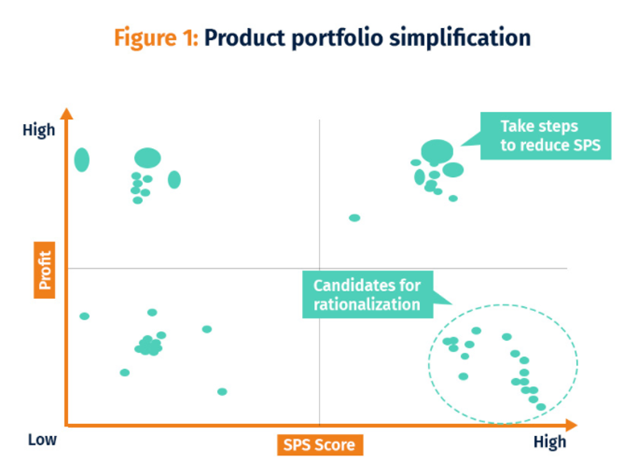
Reducing complexity can increase certainty—and sales.
2. Source raw material dynamically
Build a dynamic sourcing plan that optimizes orders over the network in each planning cycle after observing demand signals and supplier’s performance scorecard. Rather than adjusting the proportion of shipments from each supplier, this configuration allows firms to minimize costs and reduce the risk while providing timely shipping of orders.
3. Optimize pricing to shape demand
During times of supply disruption, channels can adjust pricing to curb demand while maintaining/gaining revenue. There are three options for making an impact by optimizing pricing:

When there are supply constraints, a CPG may utilize one or a combination of the three to impact the market. In the case of long-term supply disruption, raising list costs is a must. With EDV pricing, you must factor in channel coherency, price gaps compared to the key competition, brand role within the category, retailer price guidelines and their impact on consumer demand. In addition, CPGs should look for ways to shift consumer demand from the most impacted products to the least impacted products within their category portfolio. For short-term challenges, the quickest action a CPG can take is to adjust upcoming promotional plans to curb high volume demand. There is a risk that households will switch their spending to competitive brands; however, this risk is reduced during supply-chain issues since it is typically an industry-wide problem.
4. Adopt out-of-stock and on-shelf availability alerts
An automated alert system can pre-empt out of stocks based on real inventory levels (after accounting for phantom inventory) and expected sell-out trends in the upcoming days and weeks. Organizations should increase POs well in advance based on these alerts, so stock is replenished before inventory runs out. Machine learning can raise alerts for misplaced, damaged and/or phantom inventory within stores and include a mechanism to alert the store task force directly.
5. Build a smart allocation strategy
Finally, savvy organizations should distribute inventory in distribution centers and fulfillment centers based on trends, which can be gauged through an accurate and precise demand-sensing exercise done at the SKU level. Allocate higher inventory in the hot spots or high-demand clusters and maintain healthy stock levels elsewhere.
Accelerator-based machine learning solutions can help CPG companies take these steps and more, saving time, money and energy. Machine learning algorithms working together with employees can help companies across the globe navigate ongoing supply chain challenges while delighting their customers, treating their employees well and delivering on their promises.
La entrada 5 keys for CPG firms to better manage the supply chain crisis se publicó primero en Shelfmanager.
]]>La entrada Fighting food waste with AI and SKU-level task management se publicó primero en Shelfmanager.
]]>Worldwide, food waste is one of the main challenges facing modern society. FAO studies indicate that 1/3 of the food produced worldwide is wasted. According to The Guardian, levels reach 45% of total production in the US; 35% of seafood, 30% of cereals, and 20% of meat and dairy products each year.
In parallel, the impact of Covid-19 has exacerbated food insecurity across the world. FeedAmerica studies show that 1 in 6 Americans lack reliable food access, while paradoxically, tons of food that are fit for consumption are wasted every day.
Food waste also has an environmental impact. We are talking about the resources used for production and transportation, such as soil, water, and energy. According to ReFed’s analysis, the cultivation of uneaten food is responsible for 14% of the total potable water used and 4% of greenhouse gases in the US.
The effect of food spoilage does not end there. It also has economic consequences. According to The Guardian, in the United States alone, 218 billion dollars a year are lost in producing, processing, and transporting food that is not consumed, equivalent to 1.3% of the country’s GDP.
For food retailers, such as supermarkets and C-stores, food waste represents one of the biggest challenges in inventory management and store operations going forward. They must keep in mind a crucial factor for their industry: perishability. Unlike other retailers, the food area handles a wide assortment of products with low shelf life, such as fruits, vegetables, and bakery products — and the more varied the mix of fresh produce, the greater the retailer’s risk of food waste.
Today we see how the triad of economic, social, and ecological factors push retailers to take responsibility for waste reduction as a global improvement opportunity. Fortunately, technological solutions come to support stores to prevent, control and reduce food waste.
Retailers tackling food waste
Retailers have a pivotal role to play in the fight against food waste, given their strategic position between producers and consumers. Here are three areas of work that retailers should focus on to make a difference.
Demand planning
The demand planning system is the first step in the supply chain and is directly related to each store’s product inventory level and its risk of shrinkage. Excessive demand forecasting will generate excess inventory in the stores. If these products are not purchased, the retailer may be forced to implement markdowns to encourage consumption, directly affecting margins. Excess inventory can eventually lead to product spoilage and its consequent economic losses and ecological impact.
Inventory analysis with AI
Let’s assume that the retailer has the right inventory level, thanks to its excellent demand planning and supply chain management. The next step is to manage this inventory in the best way to prevent product spoilage. A robust analytics system, integrated with AI and machine learning, will help retailers understand when a product is at risk of being wasted due to low turnover.
Reliable SKU-level data will be essential for algorithms to deliver quality analysis to support management and increase the chances of avoiding waste.
Store operations
Once inventory planning and data analytics are in place, they must be translated into reality: the stores’ everyday operations.
The use of AI will provide retailers with information about the risk of shrinkage. But knowledge without management does not achieve results. It is vital to have a technological tool like Frogmi, which allows task management at SKU-level in each store.
When selecting technology, retailers must consider that store associates’ days are overloaded with tasks, making time an increasingly scarce resource. Therefore, to achieve effective management that limits food waste, a user-friendly, action and product-oriented solution must be implemented.
The advantages of an SKU-level task manager
An SKU-level task manager, as ShelfManager, feeds directly into the AI analysis results to generate automatic product review tasks for every store. In-store personnel receives the tasks to take action to prevent product shrinkage in the mobile App. Frogmi indicates which products need to be checked at SKU level according to the store’s inventory. Hence, each store receives accurate information for management, avoiding wasted time evaluating what to check and where. Tasks can also be prioritized so that the store operation knows where to focus management for the most significant impact.
The flexibility of the tool and the integration of logic make Frogmi a simultaneous control and management solution. On the one hand, the task is sent to perform an SKU evaluation. Staff can be asked to review the status of products at risk, such as validating expiration and order dates by shelf life or FEFO (First Expires, First Out). In this way, the store can improve visibility and control of the situation. In addition, the task manager allows management of the product and the findings made while the product is being reviewed. For example, the store can be asked to report its actions in each case, such as activating a new promotion, donating, or reducing products. Thus, shrinkage risk management goes beyond information, encouraging decision-making and problem-solving from the store.
Implementing task management technology tools such as Frogmi also opens spaces for measuring results and creating KPIs, such as the level of shrinkage, activated promotions, sales, and management of products at risk of shrinkage. Our integration with native business intelligence (BI) dashboards provides fast real-time visibility of results for stores and headquarters.
Frogmi is a robust and easy-to-use application. Its implementation in conjunction with advanced analytics helps retailers increase margins, raise productivity, and decrease shrinkage. With the ability to manage tasks at the store and SKU level, retailers can improve their customers’ experience by delivering fresh and varied products while fighting food waste.
La entrada Fighting food waste with AI and SKU-level task management se publicó primero en Shelfmanager.
]]>La entrada Technology to improve product availability in Dark Stores se publicó primero en Shelfmanager.
]]>All sales projections made it clear that online commerce would boom. According to Statista, “E-commerce sales worldwide will expand frenetically in the coming years. In 2018 they reached US$2.8 trillion and are expected to increase to US$4.9 trillion by 2021.” However, no one expected to face a pandemic and its effects, which have accelerated the growth of e-commerce, surpassing all expectations.
Although some retailers saw sales declines during the pandemic of up to 60%, supermarkets with online sales saw considerable progress, reporting growth of up to 300% in March 2021.
Supermarkets also benefited from the development of grocery delivery, which has a projected annual growth of 30%, according to studies by Civic Science. This service has been on the rise as consumers find it attractive to select items online and receive them at home, scheduling the day and time, allowing one of the week’s chores to be done from the comfort of home.
Along with the growth of grocery delivery, Dark Stores are emerging, allowing supermarkets and other retailers to have exclusive space to store and prepare products for e-commerce. This format, which has already been adopted by major retailers such as Bed, Bath & Beyond, Walmart, and Carrefour, has several competitive advantages. It minimizes operational and housing costs for companies and improves inventory accuracy. But the most significant benefit is felt by customers who get faster delivery, with promises of getting their products in less than an hour.
Retailers must be prepared to face some challenges that arise within this new dynamic. Among them, studies such as “Leveraging the physical network of stores in e-grocery order fulfillment for sustainable competitive advantage” highlight the major factors to be considered: integration between online and physical sales channels, logistics coordination, and inventory management.
Product availability in Dark Stores
Dark Stores satisfy an online shopping experience, but with physical product delivery. Inventory management is critical to meeting the expectations of consumers, who expect fast delivery and immediate availability. Irregularities in the store’s inventory system or products are hidden in the backroom can generate errors at the time of sale or picking, disrupting the shopping experience.
When a product purchased by the customer is not available, it will directly affect indicators such as found-rate and fill-rate. The first KPI refers to the availability rate of purchased products. That is, how many products from the customer’s basket were found in the store. The second refers to the rate of full baskets. It measures how good the retailer is at delivering a complete order to a customer. Both metrics are critical, especially in competitive industries such as supermarkets, since if one retailer cannot provide the product, someone else will.
Measuring found and fill rates helps retailers know how well they can meet customer demand. It also provides information on how inventory is managed and how effective they are in fulfilling customers’ orders.
Using technology to improve KPIs
Dark Stores can find a great ally in the use of technological tools. Frogmi allows identifying shelf availability issues manually through an easy and intuitive application. The same Dark Store personnel who are picking products can identify and report stock shortages on the shelf. In this way, the available stock can be monitored simultaneously with the preparation of customer orders.
The application is native to Andriod and iOS, so it works on employees’ personal devices (such as smartphones) and specialized hardware such as PDAs. Its adaptability to different platforms is an undeniable benefit, enabling a massive and simple deployment of the tool within a familiar user interface.
Another pain for Dark Stores, and retailers in general, is that shelf stock-outs occur throughout the day as employees pick the orders. Some shelf stock robots and verification systems work at the end of the day. Once the store is closed, they go through the aisles and provide a report indicating which products are missing and need to be replenished. However, Frogmi can be used parallel to the picking process, expanding the identification of stock-outs to the entire workday. It is not necessary to wait for the Dark Store to close to recognize stock-outs. Thus, the merchandise replenishment is done continuously, improving results.
The use of technological tools will help stores to improve indicators such as found and fill rate. Remember that low performance on these indicators increases the risk that the customer will not buy or try another retailer’s service. Delivering the best shopping experience is key for the brand to continue to grow and avoid the loss of sales associated with the disappointment of not finding the desired product.
Retailers have worked hard to achieve a high-level customer experience in their physical stores. Now they have the challenge of ensuring they deliver that same level of service through their digital channels.
They need to have the right stock available for order-takers and improve KPIs such as found and fill rate to achieve their promise. Technological tools such as Frogmi are an undeniable ally to achieve this goal.
La entrada Technology to improve product availability in Dark Stores se publicó primero en Shelfmanager.
]]>