Notice: Function _load_textdomain_just_in_time was called incorrectly. Translation loading for the acf domain was triggered too early. This is usually an indicator for some code in the plugin or theme running too early. Translations should be loaded at the init action or later. Please see Debugging in WordPress for more information. (This message was added in version 6.7.0.) in /home/frogmishelf/public_html/wp-includes/functions.php on line 6131

Notice: Function _load_textdomain_just_in_time was called incorrectly. Translation loading for the wordpress-seo domain was triggered too early. This is usually an indicator for some code in the plugin or theme running too early. Translations should be loaded at the init action or later. Please see Debugging in WordPress for more information. (This message was added in version 6.7.0.) in /home/frogmishelf/public_html/wp-includes/functions.php on line 6131

Warning: Cannot modify header information - headers already sent by (output started at /home/frogmishelf/public_html/wp-includes/functions.php:6131) in /home/frogmishelf/public_html/wp-content/themes/frogmi/functions.php on line 93

Warning: Cannot modify header information - headers already sent by (output started at /home/frogmishelf/public_html/wp-includes/functions.php:6131) in /home/frogmishelf/public_html/wp-includes/feed-rss2.php on line 8
Productivity archivos - Shelfmanager https://frogmishelf.com/blog/category/productivity/ Increase sales and productivity with an optimized in-store SKU level execution Logo starbucks Logo 7 eleven Logo Bizarro Logo Farmacia ahumada Logo Bci Seguros Logo Burgerking Logo Burgerking Logo starbucks Logo 7 eleven Logo Bizarro Logo Farmacia ahumada Logo Bci Seguros Logo Burgerking Logo Burgerking Logo starbucks Logo 7 eleven Logo Bizarro Logo Farmacia ahumada Logo Bci Seguros Logo Burgerking Logo Burgerking Tue, 17 May 2022 15:27:09 +0000 en-US hourly 1 https://wordpress.org/?v=6.9.4 https://frogmishelf.com/wp-content/uploads/2022/05/cropped-favicon-frogmi-32x32.png Productivity archivos - Shelfmanager https://frogmishelf.com/blog/category/productivity/ 32 32 Why reducing waste is good for the planet and your business https://frogmishelf.com/blog/why-reducing-waste-is-good-for-the-planet-and-your-business/ https://frogmishelf.com/blog/why-reducing-waste-is-good-for-the-planet-and-your-business/#respond Tue, 17 May 2022 14:27:56 +0000 https://frogmishelf.com/blog/por-que-reducir-la-merma-es-buena-para-el-planeta-y-tu-negocio/ Food waste has long been recognized worldwide as an extensive problem...

La entrada Why reducing waste is good for the planet and your business se publicó primero en Shelfmanager.

]]>

Food waste has long been recognized worldwide as an extensive problem. Organizations such as the UN have defined reducing food waste by half by 2030 as a strategic pillar; the European Parliament passed a resolution in 2012 to halve waste in the EU by 2025; the US government stated that it seeks to reduce it by 50% by 2025. Thus, countries worldwide have aligned themselves with this strategy to address a problem that can be difficult to translate into a measurable size. According to the FAO, we are talking about 1.3 billion tons of food waste generated each year worldwide. To give an idea, this is equivalent to the weight of 22.5 Great Chinese Walls, 197 hoover dams, or 130,000 Eiffel Towers.

Food waste is clearly a problem of inefficient use of resources, with solid ethical implications if we consider that 795 million people suffer from hunger globally. It also affects the environment since the level of waste is responsible for 6% of global greenhouse gas emissions.

With these numbers on the table, there is no doubt. Reducing food waste is good for the planet. But it is worth mentioning that spoilage also equates to losses of around $680 billion in industrialized countries and $310 billion in developing countries. The economic impact rises as a third driver for mobilizing global efforts.

Wasting food is literally throwing resources away. However, for retailers, shrink management has effects that go even further. When a product expires or is recalled due to early expiration, retailers face direct shrinkage losses that affect their bottom line. This situation can be prevented by keeping low stock of the products in question and avoiding product surplus. However, this opens a new dilemma concerning lost sales due to scarce product availability. In previous blogs, we have already talked about the effect over the purchasing process of an incomplete shelf. Out of stocks brings the risk of losing sales or the customer altogether—an unfavorable scenario for any retailer seeking to satisfy the needs of its consumers. Consequently, we come to a fundamental point: the customer experience, which is affected when there’s no product on the shelf. At the same time, the shopping experience will also be harmed by seeing expired products on the shelf or when buying products that will expire soon without being warned.

Therefore, the economic impact of shrinkage on retailers can be viewed from different perspectives: direct product loss, potential sales loss, and customer experience loss. Ultimately, the complexity lies in the balance: having the right stock and in-store execution that will allow them to meet consumer demand and expectations while avoiding product loss. How can retailers meet this challenge? What tools are available?

First, optimize the demand forecasting process. Accurate forecasting is essential to have the correct quantity in the right place at the right time. Today, the market offers several solutions to optimize inventory management, supported by AI and learning systems such as Machine Learning, to adapt the results to external factors such as seasonality, weather, vacations, events, and promotions, among others.

Demand forecasting is particularly relevant for perishable products, which are abundant in supermarkets and convenience stores. These products are the most complex to manage since inventory is closely related to product expiration and shelf-life. To avoid shrinkage, retailers can get ahead of it by using preventive expiration analysis. The evaluation considers product shelf life, average turnover, and purchase dates, among others, to signal when a product is at risk of expiring.

With the speed of the retail world, an early expiration alert will probably not be enough for effective management. A task manager at product level closes the cycle, supporting the store operation and encouraging direct action to achieve results. One major advantage of using this technology is that store personnel can quickly and clearly visualize the products they need to review for expiration risk. At the same time, it will ensure the execution of a solution on the spot, such as removing expired products from the shelf or implementing a discount to increase product rotation. In addition, being a digital tool, it provides real-time traceability of the work done and its results.

When retailers aim to reduce product waste and shrinkage, everyone wins. Sustainability and social responsibility results are improved, customers find the products they want (and are not surprised by expired products on the shelf), and margins benefit. Thanks to new technological developments, retailers have ample room to empower their organizations and improve their bottom line.
La entrada Why reducing waste is good for the planet and your business se publicó primero en Shelfmanager.

]]>
https://frogmishelf.com/blog/why-reducing-waste-is-good-for-the-planet-and-your-business/feed/ 0
On-Demand Webinar: Connecting Inventory Optimization and Store Operations to Drive Sales https://frogmishelf.com/blog/on-demand-webinar-connecting-inventory-optimization-and-store-operations-to-drive-sales/ https://frogmishelf.com/blog/on-demand-webinar-connecting-inventory-optimization-and-store-operations-to-drive-sales/#respond Wed, 13 Apr 2022 19:33:04 +0000 https://frogmishelf.com/?p=4287 Watch now! Pablo Godoy, CEO and Co-Founder of Frogmi, and Mark Garland, 4R CEO, discuss how to sync corporate inventory...

La entrada On-Demand Webinar: Connecting Inventory Optimization and Store Operations to Drive Sales se publicó primero en Shelfmanager.

]]>

Watch now! Pablo Godoy, CEO and Co-Founder of Frogmi, and Mark Garland, 4R CEO, discuss how to sync corporate inventory strategies and store operations that improve staff productivity and create positive customer experiences.

La entrada On-Demand Webinar: Connecting Inventory Optimization and Store Operations to Drive Sales se publicó primero en Shelfmanager.

]]>
https://frogmishelf.com/blog/on-demand-webinar-connecting-inventory-optimization-and-store-operations-to-drive-sales/feed/ 0
Webinar Takaways: Connecting Inventory Optimization and Store Operations to Drive Sales https://frogmishelf.com/blog/connecting-inventory-optimization-and-store-operations-to-drive-sales/ https://frogmishelf.com/blog/connecting-inventory-optimization-and-store-operations-to-drive-sales/#respond Tue, 12 Apr 2022 14:23:19 +0000 https://frogmishelf.com/?p=4265 Although technology has been made available to retailers to optimize inventory management, the presence of phantom inventory remains a headache that is...

La entrada Webinar Takaways: Connecting Inventory Optimization and Store Operations to Drive Sales se publicó primero en Shelfmanager.

]]>

Although technology has been made available to retailers to optimize inventory management, the presence of phantom inventory remains a headache that is difficult to overcome. Mark Garland, President and CEO of 4R, and Pablo Godoy, CEO and Co-founder of Frogmi, shared some thoughts and strategies on how to optimize store operations and inventory management to create a more positive customer experience. 

The opportunity

Phantom Inventory is a common retail industry expression for goods that inventory accounting systems consider to be on-hand but are not actually available for purchase. There are multiple origins for discrepancies between the on-hand inventory and the recorded one, but the results are the same. 

  • Inaccurate Inventory Reporting 
  • Out of Stocks
  • Lost Sales 

The disconnection of inventory level and stock-outs leads to 2,6% lost sales for an average retailer. This problem can be even worse for slow-moving items, which are more challenging to identify on a daily basis.

4R and Frogmi are turning this inventory and store operations problem into an outstanding opportunity: connecting corporate strategies with store operations through advanced analytics and mobile solution (App) to improve store execution and mitigate these lost sales.

The solution

The partnership offers a way to improve store-level inventory positioning and availability through prioritized task management at the product level, resulting in real-time visibility, store and inventory optimization, and improved sales.  

“4R has the capabilities to consolidate and analyze inventory and sales data from retailers and identify products at risk of phantom inventory. But after identifying the issue, something must be done to confirm and solve the problem. Our approach is task management at SKU level, sending prioritized actionable tasks to every store and product” – Pablo Godoy, CEO and Co-founder of Frogmi. 

Frogmi’s Customer Success Team works directly with the client creating templates and workflows according to their needs, designing a process, questions, and actions that will be automatically triggered every time a phantom inventory event is alerted. This task can be a simple inventory report or something more complex as informing to supply chain about a stock-out or trade marketing about missing POP material for promotion.  

The information and feedback retrieved through the App are available for the whole organization, from HQ to district and store managers. It can feed BI panels, KPIs, and the same inventory system, eliminating the gap between physical and recorded stock and providing information for data-based decision-making.

Store Connected Inventory

The Solution

As retailers attempt to respond to customer needs, they continuously employ demand and assortment planning and rapid replenishment strategies to match supply and demand. Even with the best preparation, connecting corporate strategy and planning to in-store operation can be challenging. Task management at SKU level partnered with robust analytics will empower retailers and store associates. Some, but not all the benefits, are: 

  • Having the actual inventory on-hand that is needed.
  • Ensuring inventory is correctly tagged & “shoppable” in the right place .
  • Providing instructions and in-depth information to store associates, making them product knowledgeable and confident about product availability and their job. 
  • Improving the compliance of campaign and promotion implementation – marking down items at the right time. 
  • Prioritizing store associates’ time on the most impactful tasks, creating an efficient workflow, and fostering good habits.
  • Increasing visibility and communication between corporate and store operations, keeping strategic initiatives, store operations, and performance in synch.

 “Partnering with Frogmi gives our clients an advantage by improving data at the store level, therefore improving product in-stock positions while enhancing store operations. This helps us provide the best inventory visibility.” Mark Garland, President and CEO of 4R.

La entrada Webinar Takaways: Connecting Inventory Optimization and Store Operations to Drive Sales se publicó primero en Shelfmanager.

]]>
https://frogmishelf.com/blog/connecting-inventory-optimization-and-store-operations-to-drive-sales/feed/ 0
How to effectively manage phantom inventory https://frogmishelf.com/blog/how-to-effectively-manage-phantom-inventory/ https://frogmishelf.com/blog/how-to-effectively-manage-phantom-inventory/#respond Tue, 29 Mar 2022 13:57:49 +0000 https://frogmishelf.com/blog/como-gestionar-eficazmente-el-inventario-fantasma/ Phantom inventory is one of the most complex problems to deal with for retailers because, as the name implies, it is challenging to discover...

La entrada How to effectively manage phantom inventory se publicó primero en Shelfmanager.

]]>

Phantom inventory is one of the most complex problems to deal with for retailers because, as the name implies, it is challenging to discover. There is no single root cause or an identical manifestation between stores to identify it. Sometimes it presents itself as product availability errors, as the system indicates that the store has stock, even though no physical units are available. Other times, a stockout is alerted when in fact, there is none.

While retailers try to balance assortment variety in their stores with optimal inventory management, the discrepancy between physical and recorded stock can lead to significant complications. Considering that every time a customer faces a stockout, there is a 40% chance that the store will perceive a direct loss, it should come as no surprise that studies by the Consumer Brands Association (formerly known as the Grocery Manufacturers Association or GMA) estimate a $50 billion loss from out-of-stock issues in North America alone between 2017 and 2018.

Retailers should also not forget that lost sales are only one of the consequences of phantom inventory, affecting inventory management, customer experience, e-commerce fulfillment, and decision-making. So, are retailers forced to take the impact without acting? How can retailers address this problem?

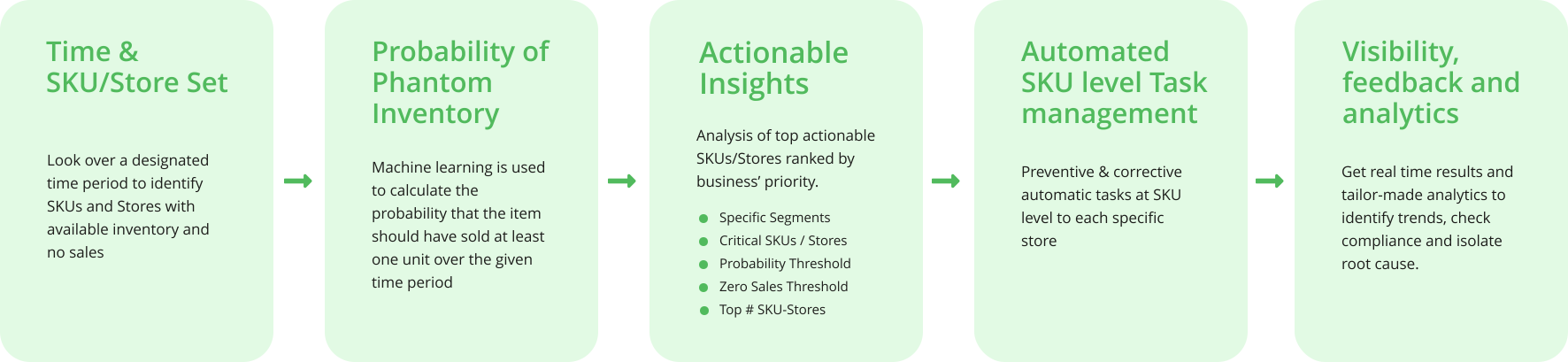
The answer is simple: data. Phantom inventory is hard to see, so the best way to identify it is to have data and analytics solutions that leverage artificial intelligence (A.I.) and machine learning (M.L.) development to see its signs or symptoms. Algorithms are fed with sales projections, inventory level, POS sales information, and more and can determine if any product presents an anomalous behavior. An anomalous sale would be, for example, having sales of a product registered as out of stock; or not having sales of alcohol gel in the middle of the pandemic if there is stock available. Thus, the probabilistic analysis of the models will be able to raise alarms when there are signals that suggest anomalies.

The critical point for effectively managing phantom inventory comes after identifying abnormalities. The retailer must ask itself what to do with this information. What action to take now that they know that some product’s sales or turnover are not behaving as expected. We are talking about converting the data into action, into concrete activities that can effectively solve the problem on the sales floor.

In our experience, the best way to get the information down to the stores is in the form of product-specific tasks. Frogmi® offers a task management solution at SKU level, which can automatically trigger tasks against A.I. alerts for the store to check the product’s status. For example, a task can be sent to audit the product’s condition, answering some basic questions: Does it have enough stock? Are the products in good condition (undamaged, not expired)? Is it displayed correctly, following the planogram guidelines? Does it have a price tag? Is the price correct? And, if a problem is found, a new task is automatically triggered to provide the solution.

Effective phantom inventory management goes beyond traditional inventory management. It is a verification of all product’s commercial variables that will help retailers ensure shelf availability and validate that the protocols and standards defined by the company are being met. We are actively reducing the gap between what is planned and executed in every store for each item. In this way, customers will be able to find the products they are looking for, when they need them, and in the best condition, improving the shopping experience and ensuring sales.

La entrada How to effectively manage phantom inventory se publicó primero en Shelfmanager.

]]>
https://frogmishelf.com/blog/how-to-effectively-manage-phantom-inventory/feed/ 0
5 keys for CPG firms to better manage the supply chain crisis https://frogmishelf.com/blog/5-claves-para-que-las-empresas-de-bienes-de-consumo-gestionen-mejor-la-crisis-de-la-cadena-de-suministro/ https://frogmishelf.com/blog/5-claves-para-que-las-empresas-de-bienes-de-consumo-gestionen-mejor-la-crisis-de-la-cadena-de-suministro/#respond Tue, 23 Nov 2021 14:15:53 +0000 https://frogmishelf.com/blog/5-claves-para-que-las-empresas-de-bienes-de-consumo-gestionen-mejor-la-crisis-de-la-cadena-de-suministro/ s probable que los compradores de todo el mundo se encuentren con estanterías vacías o desabastecimiento en los sitios web durante la temporada navideña de 2021...

La entrada 5 keys for CPG firms to better manage the supply chain crisis se publicó primero en Shelfmanager.

]]>

Analytics and data science offer opportunities to avoid stockouts

Source: www.freightwaves.com

Shoppers across the globe will likely be greeted by empty shelves or website stock-outs during the 2021 holiday season. Its a perfect supply chain storm of increased demand and severely constrained supply and labor. Pent-up demand from the pandemic is leading to an increase in both online and in-store orders while Covid-19-related restrictions, combined with container shortages, labor and driver shortages, port congestion and railroad bottlenecks, have constricted supply like never before.

Retailers inventories are near a 30-year low and toymakers are urging consumers to shop months early for holiday gifts. Shipping costs have increased by over 300% compared to January 2020. An unprecedented number of ships are waiting to dock at Southern California ports. By the end of September, 73 container ships were anchored off California, waiting for a berth. U.S. President Joseph Biden announced on Oct. 9 that the Los Angeles port will operate 24×7 to clear the backlog, but even that is not going to be enough. There is no end in sight for any of these problems.

  • More than 20% of supply chain executives are planning to reduce the number of SKUs in their product portfolio but are not sure of the overall rationalization strategy
  • More than 45% of supply chain executives want to multi-source materials and expand their supplier base but lack an expansion plan
  • More than 40% of supply chain executives aim to maintain a higher level of inventory for critical SKUs and reduce stock-out scenarios but have no visibility.

How can CPG firms deal with these unavoidable supply chain issues in the short term?

Interestingly, CPG companies that turn to data science and analytics will have a real advantage this season and beyond. Now is the right time for companies to bring in data science to address these issues, irrespective of their data journey. In most cases, companies have a better chance to succeed if they choose the right partner to help them with data science and analytics.

Following are 5 steps CPG companies can take in the immediate short term to deal with these ongoing challenges.

1.  Simplify product portfolio

CPG companies can decrease complexity within the supply chain by reducing product variations or discontinuing less profitable or high complexity SKUs. This involves 3 simple steps:

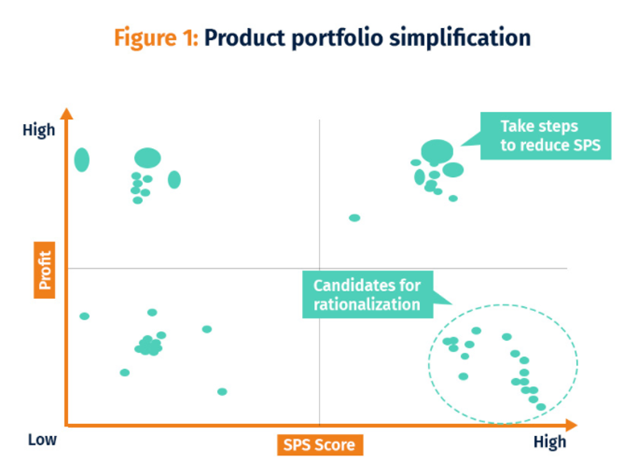
  1. SKU classification: Classify SKUs by stockout possibility score (SPS). SPS is calculated at an SKU/store (or warehouse) level and depends on:
    • Whether the item is locally sourced or not
    • Predicted suppliers performance (based on past performance with respect to demand).
    • Suppliers risk score (financial, geopolitical, operational, number of suppliers)
    • Current inventory levels compared to forecasted demand (days of supply)
  1. SKU segmentation: Segment SKUs based on profit versus the stockout possibility score. Calculate profit considering increased transportation and labor costs.
  2. SKU rationalization: Discontinue SKUs in the high SPS and low-profit segments. Keep an eye on the SKUs with high profit and high SPS scores, then take immediate steps to reduce the SPS score of these SKUs.

Reducing complexity can increase certaintyand sales.

2. Source raw material dynamically

Build a dynamic sourcing plan that optimizes orders over the network in each planning cycle after observing demand signals and suppliers performance scorecard. Rather than adjusting the proportion of shipments from each supplier, this configuration allows firms to minimize costs and reduce the risk while providing timely shipping of orders.

3. Optimize pricing to shape demand

During times of supply disruption, channels can adjust pricing to curb demand while maintaining/gaining revenue.  There are three options for making an impact by optimizing pricing:

When there are supply constraints, a CPG may utilize one or a combination of the three to impact the market. In the case of long-term supply disruption, raising list costs is a must. With EDV pricing, you must factor in channel coherency, price gaps compared to the key competition, brand role within the category, retailer price guidelines and their impact on consumer demand. In addition, CPGs should look for ways to shift consumer demand from the most impacted products to the least impacted products within their category portfolio. For short-term challenges, the quickest action a CPG can take is to adjust upcoming promotional plans to curb high volume demand. There is a risk that households will switch their spending to competitive brands; however, this risk is reduced during supply-chain issues since it is typically an industry-wide problem.

4. Adopt out-of-stock and on-shelf availability alerts

An automated alert system can pre-empt out of stocks based on real inventory levels (after accounting for phantom inventory) and expected sell-out trends in the upcoming days and weeks. Organizations should increase POs well in advance based on these alerts, so stock is replenished before inventory runs out. Machine learning can raise alerts for misplaced, damaged and/or phantom inventory within stores and include a mechanism to alert the store task force directly.

5. Build a smart allocation strategy

Finally, savvy organizations should distribute inventory in distribution centers and fulfillment centers based on trends, which can be gauged through an accurate and precise demand-sensing exercise done at the SKU level. Allocate higher inventory in the hot spots or high-demand clusters and maintain healthy stock levels elsewhere.

Accelerator-based machine learning solutions can help CPG companies take these steps and more, saving time, money and energy. Machine learning algorithms working together with employees can help companies across the globe navigate ongoing supply chain challenges while delighting their customers, treating their employees well and delivering on their promises.

La entrada 5 keys for CPG firms to better manage the supply chain crisis se publicó primero en Shelfmanager.

]]>
https://frogmishelf.com/blog/5-claves-para-que-las-empresas-de-bienes-de-consumo-gestionen-mejor-la-crisis-de-la-cadena-de-suministro/feed/ 0